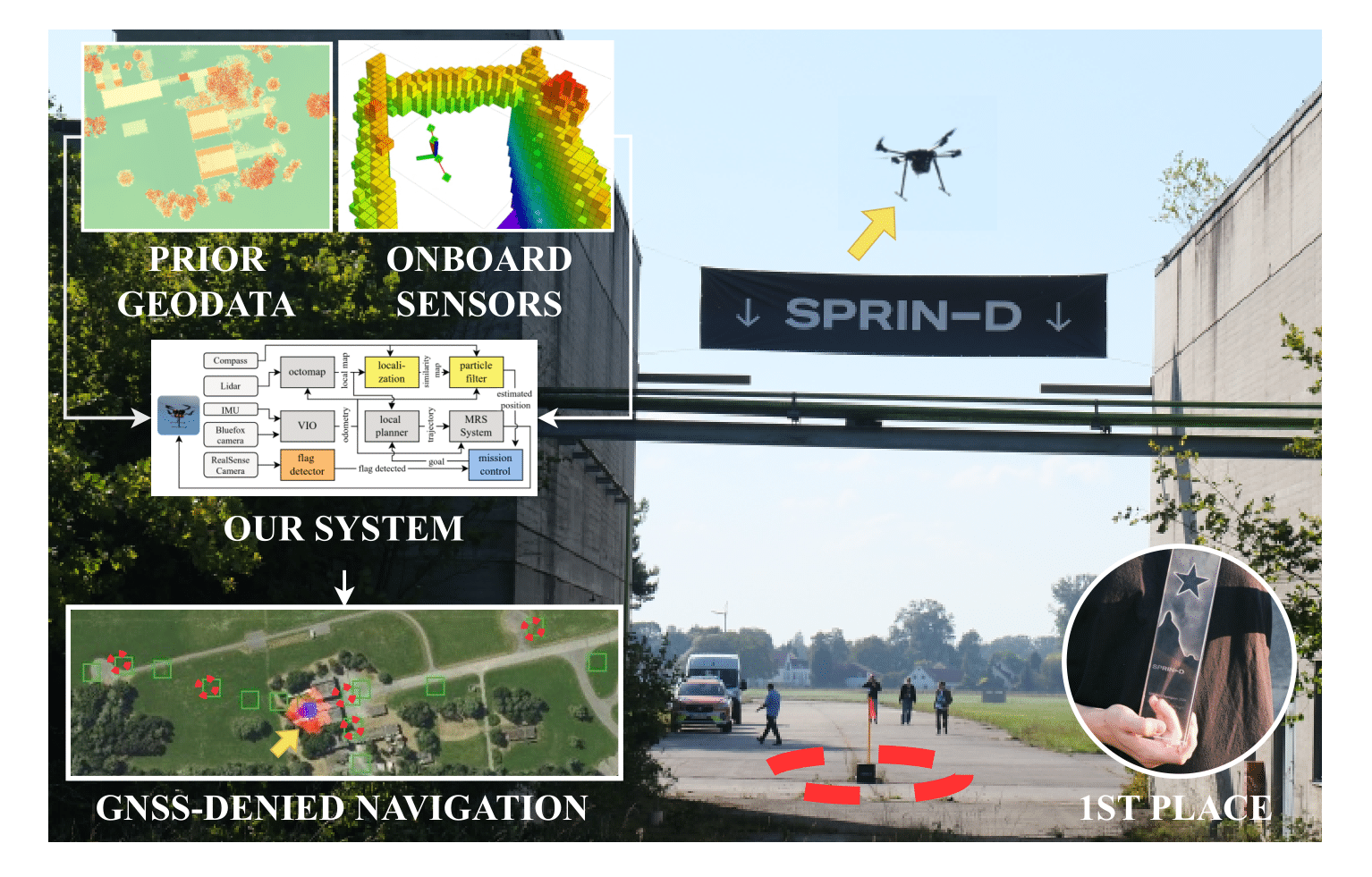
Reliable long-range flight of unmanned aerial vehicles (UAVs) in GNSS-denied environments is challenging: integrating odometry leads to drift, loop closures are unavailable in previously unseen areas and embedded platforms provide limit computational power. We present a fully onboard UAV system developed for the SPRIN-D Funke Fully Autonomous Flight Challenge, which required 9 km long-range waypoint navigation below 25 m AGL (Above Ground Level) without GNSS or prior dense mapping.
The system integrates perception, mapping, planning, and control with a lightweight drift-correction method that matches LiDAR-derived local heightmaps to prior geodata heightmap via gradient-template matching and fuses the evidence with odometry in a clustered particle filter. Deployed during the competition, the system executed kilometer-scale flights across urban, forest, and open-field terrain and reduced drift substantially relative to raw odometry, while running in real time on CPU-only hardware.
We describe the system architecture, the localization pipeline, and the competition evaluation, and we report practical insights from field deployment that inform the design of GNSS-denied UAV autonomy.